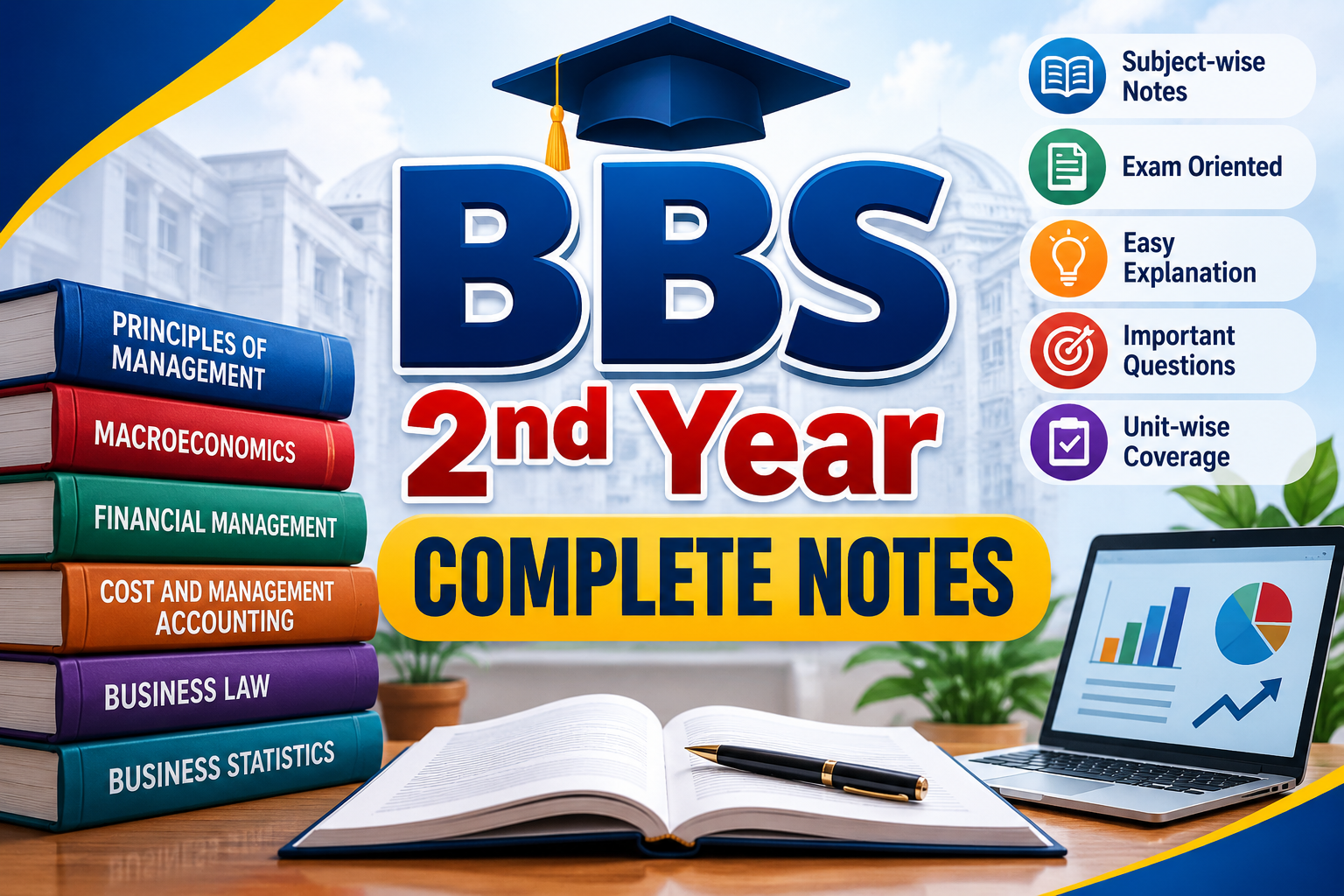
BBS 2nd Years- Cost & Management Accounting- Complete Notes for TU student
Written by Prepared With Chandeshwar Das
About This Digital Edition
BBS Second Year — Cost & Management Accounting
Complete Solved Ebook
CHAPTER 1
CONCEPTUAL FOUNDATION
BBS Second Year — Cost & Management Accounting (MGT 212)
________________________________________
Learning Objectives
After studying this chapter, you should be able to:
1. Define cost accounting and cost accountancy.
2. Explain the objectives and importance of cost accounting.
3. Discuss the scope, advantages and limitations of cost accounting.
4. Define management accounting.
5. Explain the importance/significance of management accounting.
6. Explain the limitations of financial accounting from a managerial perspective.
7. Differentiate financial, cost and management accounting.
8. Define cost and explain its importance.
9. Understand basic cost concepts.
10. Differentiate cost, expense and loss.
11. Explain cost centre, profit centre and cost unit.
12. Explain direct and indirect costs.
13. Explain fixed, variable, semi-variable and other important cost classifications.
14. Explain cost segregation.
15. Calculate fixed cost and variable cost using the high-low method.
16. Estimate cost at a particular level of activity.
17. Solve basic least-squares cost estimation problems.
________________________________________
1.1 INTRODUCTION TO COST ACCOUNTING
A business organization incurs different types of expenditure while producing goods or providing services. It purchases materials, pays wages and salaries, uses electricity, rents buildings, maintains machines and incurs administrative and selling expenses.
Financial accounting can show the overall financial result of the organization. However, management often requires more detailed information.
For example:
• What is the cost of producing one unit?
• How much material cost was incurred?
• Which department has excessive cost?
• How much is labour cost per unit?
• What is the production cost?
• Why has total cost increased?
• Which product is more profitable?
• What will happen to total cost if production increases?
Cost accounting provides information needed to answer such questions.
Definition of Cost Accounting
Cost accounting is a systematic process of recording, classifying, analysing, allocating and reporting costs relating to products, services, jobs, processes, departments or activities.
In simple words:
Cost accounting is the accounting system used to determine, analyse and control the cost of producing goods or providing services.
________________________________________
1.2 COST ACCOUNTANCY
Cost accountancy is a broader concept than merely calculating cost.
It involves the application of costing principles, techniques and procedures for:
• determining cost,
• controlling cost,
• reducing unnecessary expenditure,
• measuring efficiency,
• preparing cost information,
• planning,
• and supporting managerial decisions.
Costing vs Cost Accounting vs Cost Accountancy
Basis Costing Cost Accounting Cost Accountancy
Meaning Process of determining cost Recording and analysing cost information Broader application of cost principles
Main purpose Find cost Record, classify and analyse cost Determine, control and use cost information
Scope Relatively narrow Wider Broadest
Example Cost of producing one table Recording material, labour and overhead Using cost data to control production and make decisions
Easy way to remember
Costing → Find cost
Cost Accounting → Record and analyse cost
Cost Accountancy → Use cost information for control and management
________________________________________
1.3 OBJECTIVES OF COST ACCOUNTING
The major objectives of cost accounting are discussed below.
1. Cost Ascertainment
The primary objective is to determine the cost of products, services, jobs, processes or activities.
For example, if a company produces 10,000 units at a total cost of Rs. 800,000:
Cost per unit=Total CostUnitsCost\ per\ unit=\frac{Total\ Cost}{Units} =Rs. 800,00010,000=\frac{Rs.\ 800,000}{10,000} =Rs. 80=Rs.\ 80
Therefore, the cost per unit is Rs. 80.
________________________________________
2. Cost Control
Cost accounting helps management compare actual costs with:
• budgeted costs,
• standard costs,
• previous-period costs.
If actual cost is higher than expected, management can investigate the reason.
________________________________________
3. Cost Reduction
Cost accounting identifies unnecessary expenditure and opportunities for permanent cost reduction.
For example, if excessive material waste is discovered, management can improve production procedures.
________________________________________
4. Measurement of Efficiency
Cost information helps measure the efficiency of:
• workers,
• departments,
• machines,
• production processes,
• branches,
• managers.
Customer Reviews (0)
No reviews yet. Be the first reader to review this book!
Digital Guarantee
- 100% Genuine Verified Digital File
- No DRM lock - read across all devices
- Redownload anytime from My Orders